Steel Foundry vs Iron Foundry: What's the Difference and Which Do You Need?
Choosing between a steel foundry and an iron foundry shapes the cost, strength, and longevity of a finished cast component. This article explains the key differences, covers the trade-offs in material properties, and helps engineers and procurement teams identify which process best suits their project.
What Is the Difference Between a Steel Foundry and an Iron Foundry?
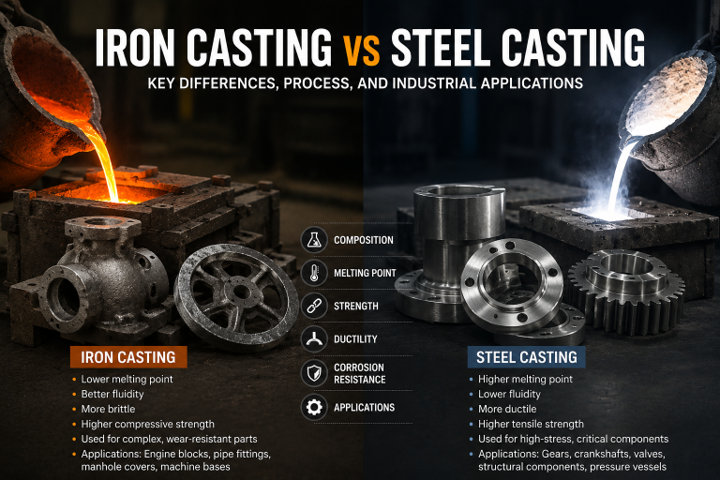
Steel and iron foundries both melt and pour metal into moulds, but they work with fundamentally different alloys. A steel foundry melts steel alloys, which are iron-carbon compositions containing less than 2% carbon. That lower carbon content gives steel its tensile strength and ductility. An iron foundry melts cast iron, which typically contains between 2% and 4% carbon. The higher carbon content makes cast iron harder and more brittle than steel, but easier and cheaper to pour into complex shapes.
The two processes use different furnace temperatures, fluxing agents, and moulding sands, so a foundry specializing in one material is not automatically set up to run the other. Understanding this distinction before approaching a supplier can save considerable time in quoting and tooling.
What Are the Mechanical Differences Between Steel and Iron Castings?
Steel castings offer higher tensile strength, greater impact resistance, and better weldability than cast iron, making steel the preferred choice wherever a component must absorb shock loads, operate under fluctuating stress, or be repaired by welding.
Cast iron, particularly grey iron and ductile iron, has excellent compressive strength and vibration-damping characteristics, along with a natural self-lubricating quality well suited to sliding surfaces and wear applications. Machinability is generally superior in grey iron, which can reduce downstream production costs.
The key mechanical trade-offs are:
▸ Steel castings deliver higher tensile strength and impact toughness, making them appropriate for dynamic, load-bearing applications.
▸ Grey iron provides superior vibration damping and is often the first choice for housings, bases, and counterweights where compressive loads dominate.
▸ Ductile iron sits between the two, offering improved elongation compared to grey iron while remaining cost-competitive to produce.
▸ Austenitic manganese steel is a specialized grade suited to extreme abrasion environments such as crushing and rail trackwork.
Which Industries Typically Use Each Type?
Steel casting applications commonly include rail and trackwork components, mining wear parts such as jaw plates and blow bars, defense and infrastructure components, and automotive applications requiring fatigue resistance under cyclic stress.
Cast iron casting applications commonly include machine tool bases and housings, pump bodies, valve housings, pipe fittings, counterweights, and general engineering components produced in higher volumes where cost per kilogram is a key driver.
Melbourne's manufacturing corridor, stretching through the northern industrial suburbs and into the western region, has historically supported both steel and iron foundry work. Local industries such as rail, mining equipment supply, and architectural metalwork each draw on different casting materials, which is why operating both capabilities under one roof offers procurement teams a genuine efficiency advantage.
Cost and Lead Time: How Do Steel and Iron Castings Compare?
Steel casting is generally more expensive to produce than iron casting. Steel melts at a higher temperature, increasing energy consumption and refractory wear. Steel is also less fluid than cast iron when molten, meaning pattern design requires more careful attention to feeding and gating, which can add to tooling complexity and pattern costs.
Cast iron pours at a lower temperature, flows more readily into intricate mould cavities, and typically requires fewer risers and gates to achieve a sound casting. These factors translate to a lower cost per kilogram and shorter casting cycle times compared to steel.
Lead times for both materials depend on pattern availability, order volume, and component complexity. For prototype or one-off castings, additive manufacturing methods can now produce sand moulds and cores directly from CAD data, significantly compressing tooling lead times for both steel and iron.
How to Decide Which Material Your Project Needs
The choice of material should follow the engineering requirement. A few guiding questions can help narrow the selection:
▸ Will the component experience impact loads or dynamic stress in service? If yes, steel casting is generally the stronger candidate.
▸ Does the part need to be welded or modified in the field? Steel is far easier to weld reliably than cast iron.
▸ Is vibration damping or cost-efficient high-volume production the priority? Grey or ductile iron often serves these requirements better.
▸ Does the application involve extreme abrasion, such as crusher wear parts or rail crossings? Austenitic manganese steel or wear-resistant alloy steel is likely the correct specification.
If a project sits between the two materials, consulting a foundry with in-house materials expertise and a testing laboratory can help confirm the specification before tooling is committed.
Talk to Melbourne's Iron and Steel Casting Specialists
Beckwith Group operates both iron and steel foundry capabilities from its Coburg North facility, giving Melbourne's engineering and procurement teams access to material selection advice and casting solutions across a wide range of alloys and component sizes. Whether your project calls for manganese steel wear parts, ductile iron housings, or a one-off prototype, the team can help identify the right material and process for your application.
To discuss your casting requirements, contact the team directly or explore the full range of steel foundry services available through the group. You can also find Beckwith Group on Google to read reviews and get directions to the Coburg North site.
Call (03) 9354 383 to speak with a specialist about your project.